
INTRODUCTION
The drone as a sonic phenomenon has a deep and rich history in various music traditions, religious practices, sound art and performance art. Detailing how its functions and meanings vary across cultures is beyond my purpose here, but a brief historical overview is useful to evidence how these practices share a focus on tonal grounding and spatial resonance (1).
For example, in Scottish music the Highland bagpipe drone works as an acoustic frame that stabilises melodic movement and defines the modal scale. In the music of the Balkans, the ison drone defines the modal colour of the melody and provides a strong base for musical expression. In Indian Raga performance, the tanpura provides a continuous reference tone that articulates time and pitch relationships, anchoring melodic improvisation within an evolving temporal field. In Australian Aboriginal traditions, the cyclical breath patterns from the didjeridoo drone are linked to rhythmic continuity and landscape; they are central to ceremonial, social and ecological contexts. And from the 1950s onward, composers such as La Monte Young, Terry Riley, Pauline Oliveros, Steve Reich, Philip Glass, Hildegard Westerkamp and Phill Niblock (to name a few) reimagined the drone as a sustained field of harmonic stasis and psychoacoustic intensity; a medium for perceptual exploration and intentional listening practices.
The wealth of existing examples reveals a cross-cultural continuum in which the drone functions not merely as background, but as a structural space.
This idea is fundamental to International Drone Day, which is essentially a celebration of all things that can be construed and understood as drone – including sonic, visual and movement-based practices. Drone Day occurs once a year around the globe, at the end of May, inviting participants from all walks of life to spend time with long tones, with the ephemera, with the inexorable pull of the ambient soundscape around us. It invites curiosity and serious play, offering a resistance to commercialisation, a recognition of the indeterminate and an acknowledgement of the mysterious.
Marie LeBlanc Flanagan (2), who conceived International Drone Day in 2014, announces the date of this special 24-hour period on droneday.org, every year. Beyond showing who has participated in the past, this website includes audio and video archives as well as interactive drone games. One can see how widespread the celebration is, and that it keeps growing. Since 2022, we host our Drone Day celebration at our fixer-upper home in the Hudson Valley, welcoming around ninety musicians and sound artists, and over fifty invited guests from across New York, New Jersey, Connecticut, Pennsylvania, Massachusetts and Canada.
Why is Drone Day important? I will explore this question through multiple angles, starting from a conversation with its progenitor and proceeding with an examination of some of its cultural implications, healing aspects and related sociological phenomena. This overview will further ground a report on the genesis, the evolution and growth of our celebration of International Drone Day in the Hudson Valley – including audio recordings from conversations with several sound artists who have participated regularly, and who have been pivotal forces in drone music as a whole. The photos in Figures 1 through 3 reveal two of our three stage-areas, outdoors and indoors.

Figure 1: Michael Jay’s gong set up and Katie Down’s steel cello on the Drone Stage. Marlboro, NY. May 27, 2023. Photo by Katie Down.
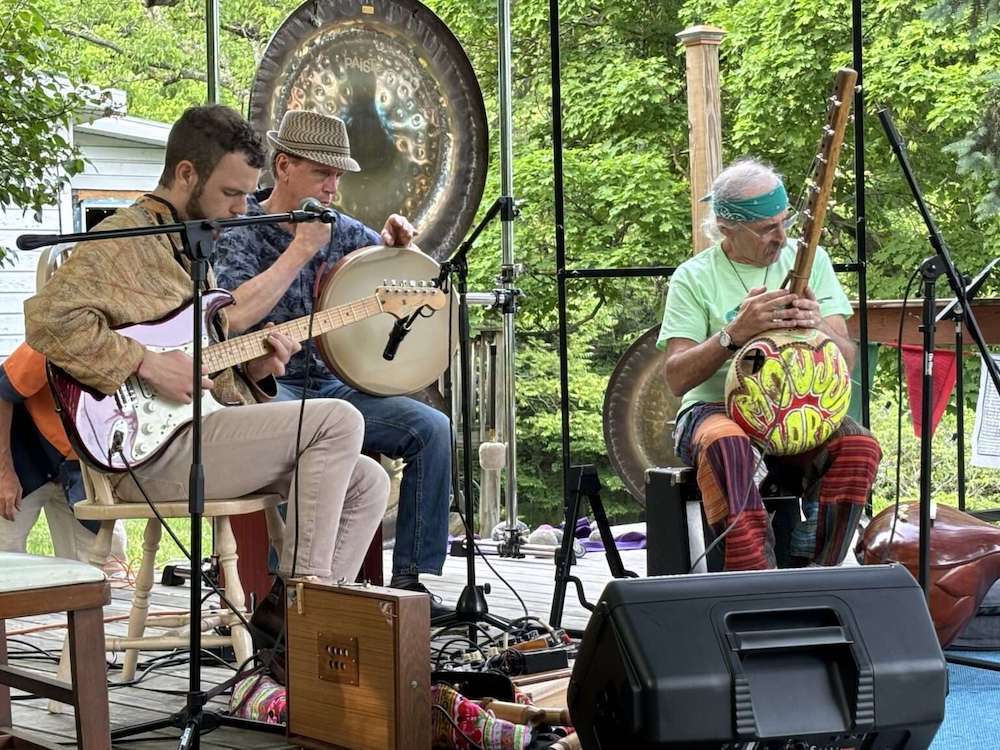
Figure 2: From left – Adrian Di Mateo, David Budd, Peter Blum on the Drone Stage. Marlboro, NY. May 27, 2023. Photo by Katie Down.

Figure 3: From left – Irman Peck, Al Margolis and Craig Chin. Marlboro, NY. May 25, 2024. Photo by Tamalyn Miller.
THE ORIGINS: A TALK WITH MARIE LeBLANC FLANAGAN
To present the origins of Drone Day in a lively manner I transcribed a phone conversation with its progenitor (Fig. 4), whom I met in Montreal two years ago. Flanagan is an artist and programmer who thinks and works within the idea of community, building experimental games and installations. She equally served as the editor-in-chief of Weird Canada, an online platform for Canadian underground music and a launching point for Drone Day – which emerged as a rebellious response to the commodification of music.

Figure 4: Marie LeBlanc Flanagan at Society for Arts and Technology. Montreal, Canada. September 29, 2024. Photo by Maryse Boyce.
Below is an excerpt from our conversation, recorded in 2025.
Marie LeBlanc Flanagan (MF): I grew up next to a creek, and used to crawl into the corrugated metal pipe wearing big rubber boots. I’d go in there and make long, extended sounds — singing in a made-up language, drawn-out tones to the frogs and to my cats waiting outside. I grew up going to music festivals. And Drone Day started about eleven years ago, in 2014, when Record Store Day was coming, and a big Beatles box set was about to be released. I was frustrated, because everyone I knew releasing a record had theirs delayed because of it. I wanted to make a day for my community, for the people around me.
Katie Down (KD): Can you tell us a little about Weird Canada, where Drone Day started?
MF: Weird Canada began as a tiny music blog. It grew quickly — a few campus radio folks, music lovers. At some point, we were nominated for Best Music Website in Canada. We were not big, but we asked people to vote and were shocked by the response. I think people were voting not just for the blog, but out of frustration with how the internet had promised connection and flat hierarchies — and wasn’t delivering. We incorporated as a nonprofit. I hosted weekly tea parties across the country, where we talked about what we struggled with, what we had to offer, and what we wanted to build. We had six hundred volunteers at one point. We wrote about music, toured, and worked to make music spaces safer — fighting back against transphobia, racism, sexism. It was an incredible, beautiful time.
KD: And how long did Weird Canada exist? Or does it still?
MF: When I got tired, I asked: “does anyone want this full-time unpaid job?” No one did. So, Weird Canada is sleeping for maybe six years now… But it is still there. It exists in a dreaming state — a sleeper.
KD: I would love to hear more about what drone music means for you, specifically. What is it about the drone that resonates? You mentioned non-hierarchical structures — that is something I connect to as well.
MF: I think it is an easy genre to enter. The door is open. Drone feels like waves — layers of sound and motion. It is a state — being here or not here. Yes, people sell drone records, but it resists commodification. It is not designed to generate a product.
KD: I would love to hear about how some Drone Day celebrations you’ve experienced, whether in Canada or elsewhere, have shaped or shifted your sense of what drone can be. Even something small or intimate, like a person droning in their closet, can be powerful. What moments have stayed with you?
MF: Some stories really stayed with me. Like the person who created a snowmobile orchestra, or someone in a cage surrounded by insects. Others drone alone in a field every year. One person used to drum with a ball gag in his mouth on the streets of Toronto. There are people curled up on couches droning, and others hosting 24-hour drop-ins where people come and go. I also heard about a sound bath in a pool — that one made me laugh. I am moved by the gatherings where a community clearly loves each other. As well as by just one person droning alone, but connected to everyone else. Drone Day is about drone, yes. And more deeply, it is about finding each other through sound.
KD: There is something magical about knowing that, on that day, hundreds or even thousands of people are droning. It is a global phenomenon that most media do not cover, but that is part of what makes it so special. It is not about visibility or commerce, it’s open and not transactional. And now, proceeding with our interview, what does listening mean to you?
MF: I remember being at a festival at Grey Area in San Francisco, lying down and feeling the drone through human bones. For me, listening is vibration. Conceptually and physically.
KD: Listening is such a vast concept…
MF: I went to a sound bath once that was all about ‘bad sounds’. But when you frame it like “I want to hear the most annoying sounds” they stop being annoying. So much depends on the listener, their engagement defines the sound. And magic exists in all spaces. The dusk of existence, the sunrise, the sunset, the edge… Oceans blending. Places where one thing becomes another. I would love to hear about what inspired you to create that kind of space.
My conversation with Flanagan was much longer, but it seems appropriate to interrupt its transcript here: prior to exposing how Drone Day came to exist in the Hudson Valley, in the following sections I will overview several ideas and practices that ground its existence.
WHY DRONE AT ALL?
David Reck wrote: “In India, it is said that the universe hangs on sound. Not ordinary sound, but a cosmic vibration so massive and subtle and all-encompassing that everything seen and unseen (including man) is filled with it” (3). The sonic drone is ubiquitous. Whether in urban or rural settings, crickets, wind and streams create their own continuous drones. Our nervous system, heartbeat, breath and blood flow are all forms of a drone. In consonance with this idea, I adopt a notion of ‘drone’ that expands well beyond any musical genre (see, for example, Video 1).
Video 1: Fanny Peréz Gutiérrez, dance, Michael Jay on gong, Adam Taylor on flutes and pedals, Greg Squared on guitar in the living room, Marlboro, NY. 2025. Footage by Katie Down.
THE DRONE AS CONNECTING FORCE
Examining the idea of a cosmic, all-encompassing vibration as a key concept of the musical drone – understanding its vastness and potential – could be a lifelong pursuit. Beings and objects, both animate and inanimate, are always in motion on a molecular level via translation, rotation and vibration. The vibration of an object causes the surrounding air to vibrate. The eardrum vibrates as a result of the moving air, the brain interprets this vibration as sound, and so on.
In the 1920s the philosopher Martin Buber referred to how a ‘stream of sound’ runs through both humanity and the world – a continuous, underlying presence of the divine. He pointed out succinctly: “We may listen to our inner self – and still not know which ocean we hear roaring” (4). Sufi scholar Hazrat Inayat Khan equally spoke about the connecting and ubiquitous force of sound as the basis of all life:
“The life absolute from which has sprung all that is felt, seen and perceived, and into which all again merges in time, is a silent, motionless and eternal life which among the Sufis is called zat. Every motion that springs from the silent life is a vibration and creator of vibrations. The whole of manifestation has its origin in vibration, in sound. This sound, which is called nada in the Vedanta, was the first manifestation of the universe. Consequently, the human body was made of tone and rhythm.” (5)
Several decades later, Joachim-Ernst Berendt reactivated the Sanskrit word for ‘sound’ – nada – in The World Is Sound: Nada Brahma, Music and the Landscape of Consciousness. Nada involves “sounding, droning, roaring, howling, screaming” (6), and related to it is the notion of nadi – a term that means ‘stream of consciousness’.
We can tune ourselves to this stream of consciousness. As the late composer Pauline Oliveros has put it: “walk so silently that the bottoms of your feet become ears” (7). Listening is a whole-body experience; one that goes beyond hearing and demands a holistic, intentional awareness that hearing alone does not require.
Oliveros worked with musical drones on her principal instrument, the accordion, as a way to explore the depth and breadth of listening. In her introduction to Gardner’s book from 1990, she described playing long tones on the French horn as a student to improve her embouchure (8). As she began to notice the physical and psychological effects of the vibrations she developed the practice and philosophy of deep listening.
Deep listening engages all the senses, expanding awareness inward and outward. In Sonic Meditations, Oliveros invites readers — regardless of musical training — to explore sound experientially. She notes: “drones of all kinds, such as motors, fluorescent lighting and freeway noise are ever present. The mantra of the electronic age is hum rather than Om. These constant soundings influence everyone whether consciously or unconsciously” (9). She posits that deep listening is “learning to expand the perception of sounds to include the whole space/time continuum of sound”; it involves “heightening and expanding consciousness in as many directions of awareness and attentional dynamics as possible”.
THE HEALING ASPECTS OF DRONE AND DEEP LISTENING
The musical drone and the act of deep listening became essential to my clinical sound practice through my personal meditation, work in sound design and composition, and study with Pauline Oliveros. I continue to explore its wide-ranging impact across improvisation, community-building and sociocultural events.
The drone resonates with our natural homeostatic state – the body’s ability to maintain a stable, balanced internal environment. It functions as both a personal and interpersonal connecting force. One can clearly sense this in Videos 2 and 3.
Video 2: From left – Marco Dianes, Barbara Gogan, Terry Dame in the barn space. Marlboro, May 24, 2025. Footage by William Loeb.
Video 3: Matt Samolis and Jon Clancy, with bowed metal. Cottage stage. Marlboro. May 24, 2025. Video footage by Bill Loeb.
Stephen Nachmanovitch observes that sound can affect our biorhythms through entrainment (10); the term, which designates a process where one oscillating system influences another to synchronise their rhythms, was adapted to music studies by the music therapist Mark Rider in the late 1980s. We can easily entrain with music and with one another. For example, when we hear music with a beat we often tap our feet. And in a performance context, when entrainment occurs the separateness of audience and performers can disappear. Also, when groups of people are entrained like in a choir, orchestra, theatrical troupe, or in a ritual in which sound is an integral part, the individual becomes part of a whole. In that process, the dissolution of fragile ego states can take place.
At the basis of healing music is the drone – a long, uninterrupted tone or chord (11). Indeed, the musical drone is integral to many cultural rituals and healing practices, including trance induction, hypnotherapy, Reiki and sound meditation. Many healing practitioners use drone-like instruments such as singing bowls, gongs, monochords, tuning forks, frame drums or vocal toning to enable a process where painful or damaging life stories begin to transform into sources of healing and growth.
The grounding quality of musical drone and the freedom it offers within its steady container can support deep psychological shifts, whether a person feels pain or not. John Cage once described this effect in his own way: he would fall asleep with the TV on, using its background drone as a kind of lullaby (12).
Importantly, drones are not inherently therapeutic. As with any clinical tool, trial and error plays a role, and it is vital to maintain an open dialogue with people before introducing drone-based interventions. Because responses vary, sound-healing practitioners must be trained to recognise when a drone is ineffective or counterproductive, especially in liminal or trance states. Used thoughtfully, it can help the central nervous system regulate and return to homeostasis.
Techniques such as humming can ease pain, aid focus and support nervous system regulation. Sylvia Nakkach speaks of the unstruck sound, which she considers the primordial sound of the universe: “the sound that is not heard except in the heart and in ecstatic consciousness” (13). Notablly, Abdullah Alshami explains that, with around forty-thousand neurons, the heart communicates neurologically, biochemically, biophysically and energetically. The vagus nerve, 80% afferent, sends signals from the heart to the brain — more signals, in fact, than the brain sends back (14).
The unstruck sound, the roar of silence, the liminal space: these terms may help explain why the drone’s healing properties are so accessible. The drone simply resonates with our natural biorhythms — our breath, blood, nervous system, and the quietude within bone and blood. Once we enter the space of deep listening, we can begin to hear what the body-mind is telling us. For the sound-healing practitioner, this informs what sound is needed in the moment. In fact, when in the flow of listening, one might begin to experience the phenomena of being played by music rather than playing music. As Gary Ansdell puts it:
“In music both people play together and respond to each through the sense of the music itself – its rhythmic, melodic and harmonic ‘necessities’ – how, that is, tempo ebbs and flows; how rhythms ‘want’ to repeat and develop; how melodic phrases ‘want’ to complete themselves, and so on. For much of the time, in a way not intentionally directed by either player, the music takes them up and almost, you could say, plays them.” (15)
ONTOLOGY, SPACE AND OVERTONES
One way to understand the ontological aspects of musical drone and its overtones comes from experiments by the ancient Greek mathematician Pythagoras and later philosophers. Using the monochord — a single string stretched over a board with two fixed points (nodes) — they observed that dividing the string in half produced the octave, and other divisions revealed consonant intervals within the harmonic series (16). These experiments demonstrated the open-ended nature of harmonic resonance. The nodes, or zeros, are points of no vibration in a standing wave, causing the wave to resonate between them.
In the simple version of the monochord, a single string was fixed at both ends, with one or more movable bridges to demonstrate musical ratios and harmonic relationships. Alternatively, the monochord was configured with one open drone string and a second string in unison, made tunable by a movable bridge. With two strings, varying intervallic relationships can be heard depending on the bridge’s position.
Peter Hammel observes:
“Under the terms of the ancient techniques of acoustic self-realisation, the knowledge of these interval subdivisions of a string took on the role of a link between nature and the soul. For these basic laws reveal the connection between notes and numbers: the intervals can be physically experienced, and the ratios correspond to particular feelings.” (17)
The word interval connotes space. The therapeutic potential of drone in clinical work lies in how musical intervals affect the body–mind and in our perception of what happens in that space. While a single drone can have an impact, it is often the introduction of a ‘second string’ — a tone, thought, or feeling — that enables movement, growth, self-actualisation and acceptance. Transformation occurs in the space between sounds, between breaths, between ourselves and the others.
By extension, silence is not mere absence, but a material that shapes form, audibility and dramaturgy. Many well-known artists such as Claude Debussy (18) or Sun Ra (19) have elaborated on this idea – which is equally evident in Video 4.
Video 4: From left: Kenji Garland, Tony Cenicola, Matt Motel, Andrea Williams. Living room. Marlboro, May 24, 2025. Footage by Anna Dziechowski.
The continuous vibration of the drone creates a sense of vastness while also holding space, offering containment within expansiveness. Visually, this paradox can be likened to the mandala: a form without clear beginning, middle or end, yet serving as a container for deep meditation and contemplation. Once when travelling in Croatia, I came across a young child selling her artwork on the sidewalk. Each small watercolour painting was carefully placed against the stone wall and held down by tiny rocks to keep them from blowing away. One painting that caught my eye had a series of small and large circles forming a kind of spiral. I was intrigued so I bought it from her and then noticed that there was a title on the back written in Croatian. Later that day, at my friend’s house, I asked her to translate it. It said: space and the place where space is.
Martin Buber’s I-Thou philosophy, where the flux of life is a stream of sound, addresses a fundamental meeting point between entities and events. In the words of Gary Ansdell, “that meeting is not in space and time, but space and time in meeting” (20). It pertains to an ontological idea: we are lost as separate entities, until the ‘I’ and the ‘Thou’ eventually become ‘We’. As such, contact and meeting are crucial in a therapeutic context – a space of safety and intimacy, as Donald Winnicott underscores (21). Drone not only supports this space but can also become the space itself, where meeting and meaning unfold.
The term musicking is very significant here: it was coined by musician and educator Christopher Small to describe music not only as a noun, but as a verb (22). Whether we play music with others, alone, or for an audience, we are engaging in the act of musicking, a space where time and self can dissolve. As Small wrote, “the act of musicking establishes, in the place where it is happening, a set of relationships, and it is in those relationships that the meaning of the act lies”. Ontologically, the drone becomes a way of reflecting, relating and entering dialogue. It is both connector and mirror — a source of energy exchange.
EXAMINING THE NOTION OF ALCHEMY
As an archetypal form, the drone can be related to the notion of alchemy – whose basic concept is that all things, animate and inanimate, are part of an evolutionary process, striving to reach their highest potential or most perfect form. The alchemists called this the Great Work or Magnum Opus, meaning ‘uniting one with all’ (23). As Dr. Suzanne Gieser noted in 1996, alchemy is also a psychological process, where the ego dissolves and is reintegrated — our original state being one of chaos and conflict (24). The Great Work, she writes, lies in “bringing these forces together in unified harmony”. In this context, the musical drone acts as both a disintegrating and unifying force, offering sonic space for ego dissolution and reintegration.
Alchemy has been directly referenced in musical compositions and metaphorically applied to musical theory. This is evident in the work of composer Arnold Schoenberg, often labelled atonal — though Schoenberg himself preferred the term atonical, which means ‘a merging together of all keys’ (25).
In The Theory of Harmony he described his Kammersymphonie No. 1, Op. 9. (1906) as “the perfect amalgamation of melody with harmony” where both elements “participate equally in melting down more outlying tonal relationships to form a unity and draw logical conclusions from the problems with which they have landed themselves” (26). The goal of achieving unity could be understood as a return to the fundamental, in which all partials coexist — a universe contained within a single piece of music:
“What is worth striving for is to discover everything that lies within the natural tone, to attain thereby everything of which the human brain with its powers of association and its ability to systematise is capable. What is attainable with the phenomenon outside ourselves, as far as the tone itself is concerned, theoretically speaking, has no boundaries.” (27).
Because the drone is a constant, anything can be played or sung within or against it, creating sensations of tension and release (such as a minor second resolving to the tonic, or a tritone to the perfect fifth). Our notions of consonance and dissonance continue to evolve, as do our understandings of the fundamental, centre or tonic. That can be sensed in Videos 5 and 6.
Video 5: From left – Dan Lindy, Matthew Talmage and Tamalyn Miller in the Cottage. May 24, 2025. Video by Reneé Bergan.
Video 6: From left – Ben Holmes, Matt Darriau, Hearn Gadbois, Brian Ales and Max Kutner. May 25, 2024. Footage by Katie Down.
Expanding these definitions is essential in clinical applications of musical drone, where engaging with dissonance — not avoiding it — can deepen awareness and reveal what is needed for healing. There are many possible approaches. For instance, Eileen D McKusick describes how binaural beats – where two slightly different frequencies with intervals only a few cents apart lead the brain to perceive a third, phantom tone – can facilitate an alpha-theta brainwave state (7–13 Hz), promoting calm and relaxation (28). As another example, continuous vocal toning generates bodily vibrations that foster focus and presence; Sylvia Nakkach describes it in depth (29).
The ways in which Pauline Oliveros’ deep listening exercises foster the discernment of consonance within dissonance are especially important to me. As part of an assignment for her students at the University of San Diego, she proposes:
“Listen to the environment for fifteen minutes or a longer, but predetermined time length.
Use a timer, clock, or adequate method to define this time length.
Describe in detail the sounds you hear (heard) and how you feel (felt) about them.
Include internal as well as external sounds.
You are part of the environment.
Explore the limits of audibility: (highest, lowest, loudest, softest, simplest, most complex, nearest, most distant, longest, shortest sound).” (30)
To exemplify the process, she further writes:
“My mind adheres to the sounds of myself and my environment. In the distance, a bulldozer is eating away a hillside while its motor is a cascade of harmonics defining the space between it and the Rock & Roll radio playing in the next room. Sounds of birds, insects, children’s voices and the rustling of trees fleck this space. As I penetrate the deep drone of the bulldozer with my ear, the mind opens and reveals the high-pitched whine of my nervous system. It reaches out and joins the flight of an airplane drone, floats down the curve of Doppler effect. Now, fifteen minutes since the beginning of this writing, the bulldozer has stopped for a while. The freeway one-half mile away, unmasked, sends its ever-shifting drone to join with the train whistle.” (31)
Such perceptual dynamics are foundational to acoustic ecology, which involves the study of relationships between living organisms and their environments, specifically as it pertains to sound. The term acoustic ecology was coined by R. Murray Schafer, who wrote back in 1977: “The flat lines become curved lines. But they are still without sudden surprises. When flat lines become jerky or dotted or looping lines – the machinery is falling apart” (32). Recently, Hildegard Westerkamp pointed out that “the current wars, the enormity of so many social inequalities and injustices, and most significantly the climate crisis, are signals of volatile times and an uncertain future”, stressing that “listening deeply to all that may stabilise us [and] give us real agency, focus and determination to make changes”(33).
The notion of sharawadji is important here. It was introduced by Jean-François Augoyard and Henri Torgue in 2005, and Schafer discusses it in the foreword of their book:
“The sharawadji effect arises in a situation of rupture, where perceptive confusion gives way to an inexplicable aesthetic pleasure. This element of rupture and the dynamic tension involved in the pleasure makes sharawadji closer to the sublime than the beautiful” (34).
Claude Schryer stresses how this effect is essentially a state of awareness (35). When we are free to listen to whatever we turn our attention to, we can take an active part in the creation of meaning (36). As such, the sharawadji effect helps ground Drone Day – a gathering point for those drawn to the dissolution of structure and the expansiveness of time.
OUR DRONE DAY
I have written a brief account of my personal perspective and relationship to drone music, and will now share an account of our own celebration of Drone Day.
In 2016, my husband Matt Darriau and I bought an old farmhouse on ten acres in the Hudson Valley, about two hours north of New York City. The land included a house, a collapsing barn and a small cottage — all in rough shape — but we saw their potential for art-making, performances, community gatherings and healing arts.
Eight years and countless hours of labour later, that is exactly what the place has become. When our friend and collaborator Craig Chin (37) suggested we host a Drone Day celebration, we had to choose between renovating the kitchen or building an outdoor stage. The choice was easy. Built from mostly salvaged wood donated by our neighbour, and with help from friends and my husband, the stage now hosts much more than Drone Day. While we sometimes call it the yoga deck, it is known best as the Drone Stage.
We also gutted the small, run-down cottage on the land and have been slowly turning it into an ad-hoc venue. It is remarkable how lighting and soft furnishings can transform a rough workspace into a warm, inviting listening space.
Our first Drone Day was in 2022, still in the shadow of COVID, when indoor gatherings carried a sense of risk. We had planned to host the event outdoors on our newly built stage, but rain was forecasted. I asked the performers if they would be comfortable indoors, and most replied “the drone must go on!”. So, musicians and listeners filled the living room, the porch, even the attic (Fig. 5).

Figure 5: From left – Matt Darriau, David Mason, Craig Chin and invited guests in the living room during the first Drone Day celebration at our house. Marlboro, 2022. Photo by Tom Law.
Later, the rain cleared and the music moved outside into the golden evening light. Bansuri master Steve Gorn, overtone singer Timothy Hill, and Peter Blum on Indian tanpura shared a twilight drone of Indian ragas, maple leaves shimmering in the fading sun (Fig. 6).

Figure 6: From left – Steve Gorn, Peter Blum, Timothy Hill on the Drone Stage, year one. Marlboro, 2022. Photo by Katie Down.
The results of our first Drone Day celebration exceeded our expectations by far. The willingness, desire and joy that filled the rooms and outdoor spaces were palpable. There were spontaneous collaborations, deep conversations in corners, ridiculous moments of hilarity and unexpected additions. It was clear: people needed this. To gather, to play, to listen. Because of my long history with drone music, not only as a sound artist, sound designer and composer but also as a music therapist, I was excited about the idea of a festival celebrating musical drone as a defiant act against enforced separation – about a movement back into the power of human connection.
Since that first year, when we welcomed around forty people, Drone Day has grown significantly (see the photos in Fig. 7—12, which are from subsequent years), with hundreds of people attending throughout the day, from noon to midnight. And the effects of Drone Day continue throughout the year. People talk about it, asking when the next date is, who is coming, and can we make it even longer? We have created a monthly Drone jam in the barn, and I’m curating a monthly Drone Night at a local venue.
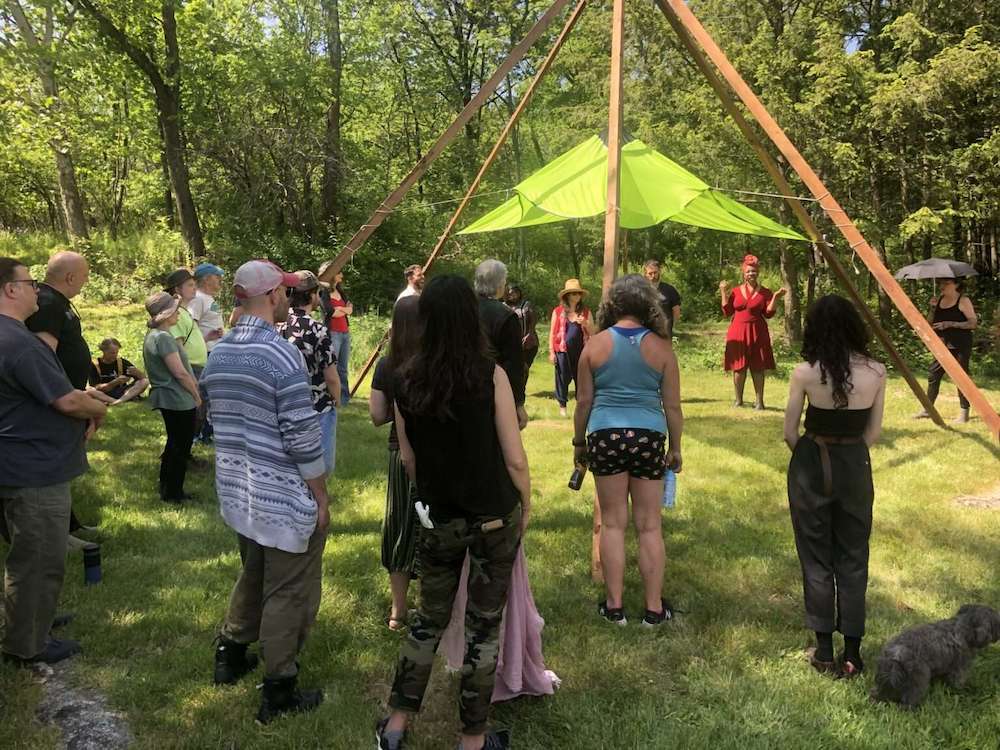
Figure 7: The singer and vocal alchemist Onome (in red) leading a circle song outside. Marlboro, 2023. Photo by Katie Down.

Figure 8: From left – Michel Marzuli, Jessica Bonds, Tom Law in the cottage. Marlboro, 2024. Photo by Katie Down.

Figure 9: From left – Sean Condron, Andrew Neumann, Rima Fand, Quince Marcum in the cottage. Marlboro, May 24, 2025, Photo by Katie Down.

Figure 10: Adam O’Callahan on theremin in the Barn. May 25, 2024. Photo by Katie Down.
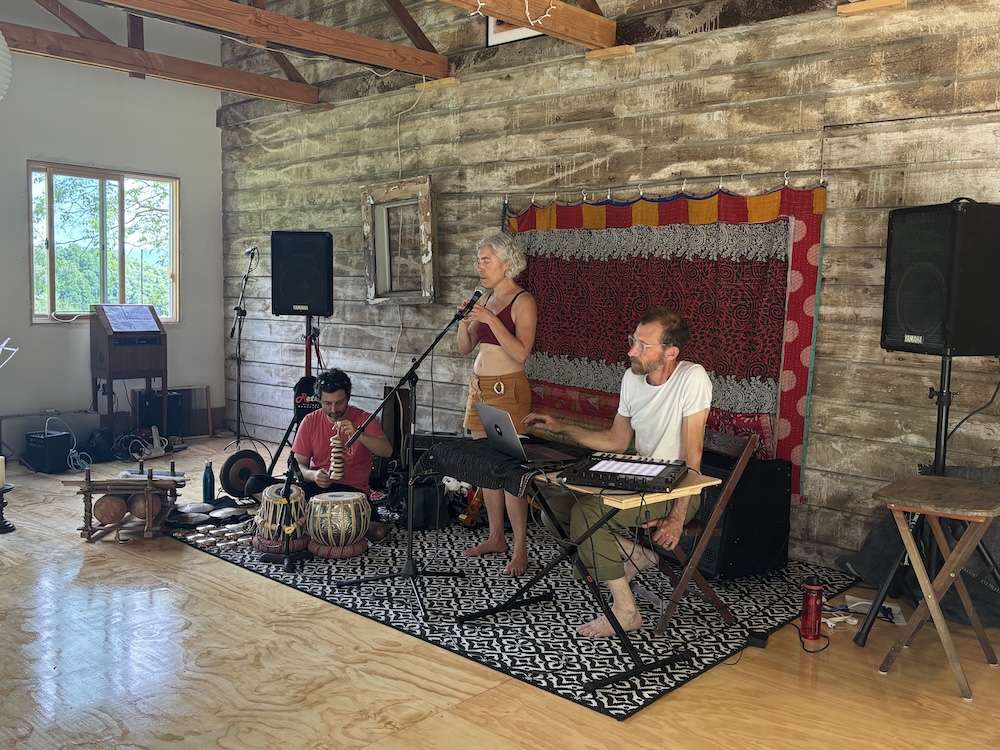
Figure 11: From left – David Freeman, Francesca Genco and Jimmy Garver in the Barn. May 25, 2024. Photo by Katie Down.

Figure 12: From left – Elana Bell, Eileen Moran, Siewli Stark, Sama Shakti and Stephanie Rooker. May 25, 2024. Photo by Katie Down.
BEHIND THE SCENES
Craig Chin, Tamalyn Miller, my husband Matt Darriau and I form the core production team of our Drone Day (Fig. 13). Planning begins months in advance, often with winter tea by the wood stove as we imagine the warmth and brightness Drone Day brings. We draft a list of musicians and sound artists we think might enjoy playing. Now in our fourth year, that list continues growing.

Figure 13: From left – “Team Drone” aka Katie Down, Tamalyn Miller, Craig Chin, Matt Darriau. Marlboro, 2024. Photo selfie by Katie Down.
Two months before the event, we send out a sign-up sheet – each set is roughly twenty minutes in length, with ten minutes allotted on either side for setup and breakdown of gear. Once the solo and fixed ensemble spots are filled, we weave in improvised musical playdates between artists who have not met or played together before.
The events take place in an outdoor stage, in the back of our barn, and in a small cottage. Performances rotate between these three zones, ensuring continuous sound throughout the day. Guests help however they can: assisting with transitions, setup, food preparation, and cleanup. And there are always listeners, whether gathered at the stages, around the potluck table, or relaxing in hammocks. Families come too, and children often listen with real interest. We have seen ten-year-olds captivated by modular synthesisers, violoncellos, saws and gongs. Some even want to perform, hence we are now considering a fourth stage dedicated to child drone artists. Why not?
THE ARTISTS WHO CORE-PRODUCE OUR DRONE DAY
Our core-production team is continuously experimenting with new ideas; I will briefly introduce who the other sound artists are. To better convey the wealth of their contributions and idiosyncrasies, I will also share audio recordings of my conversations with them.
Craig Chin (Fig. 14) is developing a project called Errant Space, which is equal parts podcast, performance and philosophical inquiry, with a focus on the ambient, abstract and improvisatory nature of drone music. Both his music and his podcast invite contemplation — perhaps not by design, but inevitably by effect. A few years ago, he began hosting his own Drone Day in his backyard in Beacon, NY. It was a casual affair, with about twenty people gathered around the fire pit and one or two musicians at a time playing drone music on the porch, or sometimes just a loop running while everyone ate and drank together in the yard. At his suggestion, in 2022 we began co-hosting the event at our place, which can accommodate more people and multiple drone areas. What began as a simple social gathering around drone music has since grown into a kind of social experiment that we continue to shape as co-curators.
Audio 1 is our conversation about drone, Errant Space, and the evolving celebration we now share. Craig reflects on why he believes Drone Day is important, what he values about its ongoing development, and the moments that continue to surprise and delight him — not only as a co-producer, but as a musical participant as well.
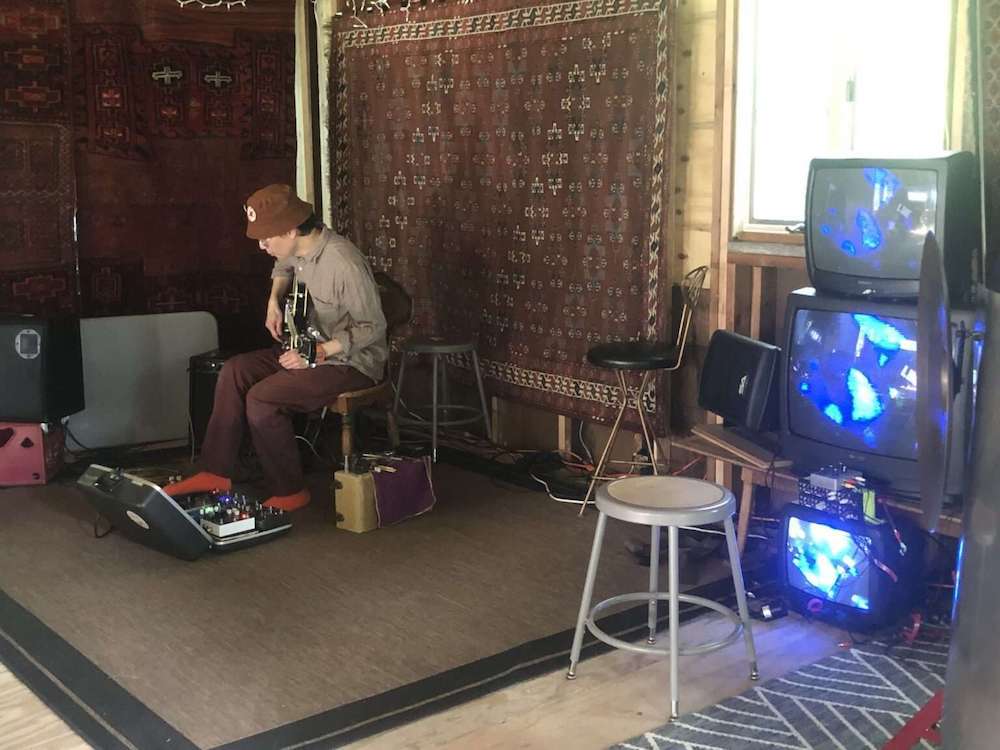
Figure 14: Craig Chin (guitar and synths) with TV monitors installation by the video artist Rooster in the cottage. Marlboro, 2023. Photo by Katie Down.
Audio 1: Conversation with Craig Chin, 2025.
Tamalyn Miller (Fig. 15) and I have been collaborating musically for several years. She is a multi-media artist living in the Hudson Valley, who works in the realms of music, sound, visual curiosities, words, hypnosis and wonder (38). She invents sonic worlds with objects found in nature, drawing out the history of the object to create a story with words and music. Tamalyn recently completed a sound walk recording and album titled Ghostpipe, which features aspects of plants and trees through original text, sound and song. She is also a member of the bands Goddess and Spirit Radio.
Audio 2 is an excerpt from our conversation that touches on how she views the importance of liminal states that the drone can elicit, hypnosis, trance states, and the significance of altered states of consciousness that the drone can provide. She speaks about her personal relationship to Drone Day and what it means for her as an artist and co-curator.

Figure 15: Tamalyn Miller, New Hampshire, X Fest, 2024. Photo by Craig Chin.
Audio 2: Conversation with Tamalyn Miller, 2025.
Matt Darriau (Fig. 16) is an integral part of our Drone Day celebration in that he built the Drone Stage, helped to rehabilitate the back of the barn and is also a regular performer on the day. He is a multi-winds virtuoso whose music spans Jazz, Balkan, Middle Eastern, traditional Irish and free improvisation (39). He plays alto and tenor saxophones, clarinet, Bulgarian kaval and gaida. One of his primary groups, Paradox Trio, was a pioneering force in combining Jazz and Balkan musics in the 1990s; they inspired musicians around the globe to work cross-culturally. Matt is also a long-time member of The Klezmatics, which was awarded a Grammy in 2006. They are set to release their 40th anniversary album soon.
In Audio 3, Matt talks about his role in making our Drone Day happen each year, what he enjoys about it, what stresses him, and what role the drone plays in his music. He speaks about the ‘homebase’ aspect of drone, and about how much of his own original music or arrangement of traditional tunes has a drone aspect, especially in the case of rhythmic ostinati and groove.

Figure 16: Matt Darriau, NYC. 2019. Photo by Katie Down.
Audio 3: Conversation with Matt Darriau, 2025.

Figure 17: David K. Freeman and Oren Neiman. Barn stage. May 25, 2024. Matt Darriau is behind the photo camera.
ADDITIONAL DRONE ARTISTS
Several composers, performers, and producers have become pivotal forces in our Drone Day celebrations through their ongoing, dedicated participation. I will share my conversations with Ken Butler, Sarah van Buren, Melissa Auf der Maur, Terry Dame, Steve Gorn and Michael Jay, along with two sound collages by Skylar Antoine. In these conversations, each artist offers a distinct perspective on drone music — its impact, its place within the broader musical landscape, and its significance in their personal practice.
Ken Butler is an artist, musician, sculptor, inventor, mad scientist and witty raconteur (40). He creates hybrid instruments from chainsaws to tennis rackets as guitars, violins and percussion instruments (Fig. 18). Ken has been an important fixture in the downtown music scene in New York for many years, and there was a recent retrospective on his work at the Culture Lab gallery in New York, which showcased his vast body of both visual and musical works.
Audio 4 is our phone conversation after Drone Day. It shares some of Ken’s ideas about his personal relationship to drone in his music and his take on Drone Day itself.
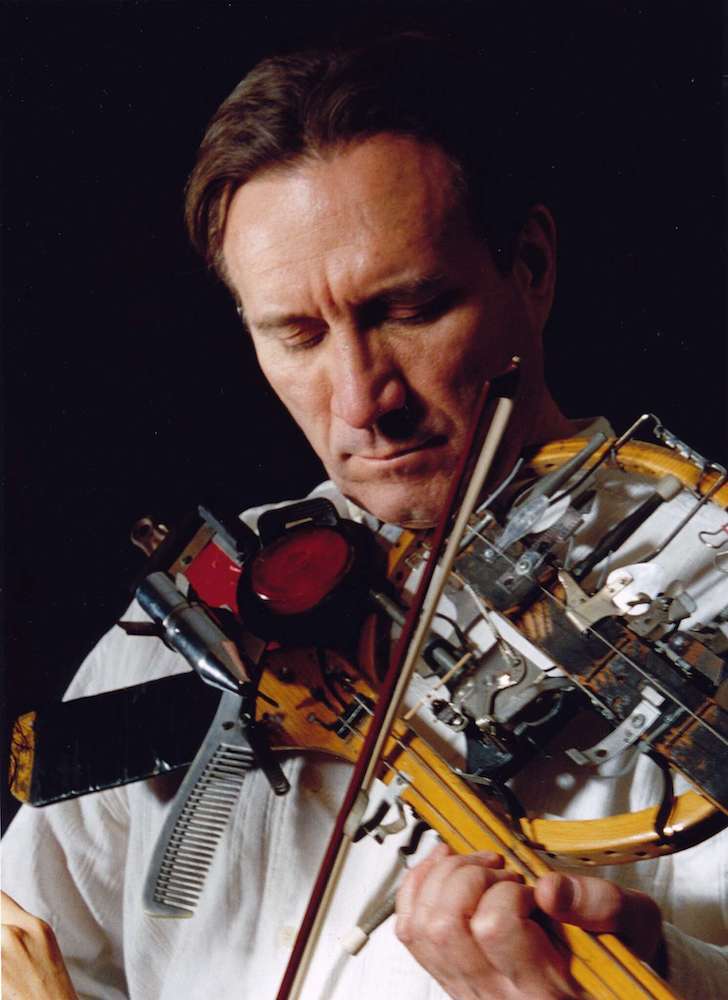
Figure 18: Ken Butler, Ann Arbor, Michigan, 2005. Photo by Tobi Hallander.
Audio 4: Conversation with Ken Butler, 2025.
Sarah van Buren (Fig. 19) is a sound artist, co-curator of the 24-hour Drone festival in Hudson and a DJ – aka SVB – in the Hudson Valley, NY (41).
In Audio 5 she shares how meditating with drone has both personal and social resonance in the wider world. In this interview, she reflects on her role in co-curating that large-scale event, and on how the deep listening philosophy of Pauline Oliveros continues to shape her musical practice. Sarah discusses the power of drone music and communal events like our Drone Day as forms of collective prayer — offering space for peace, connection, and transformation.
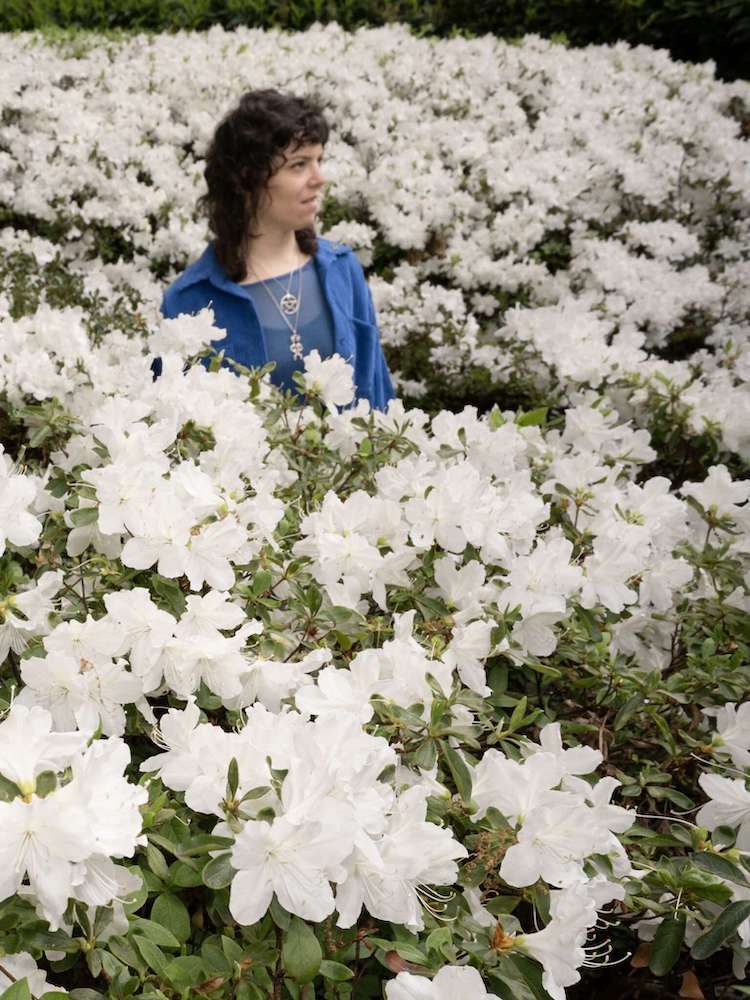
Figure 19: Sarah van Buren, NYC, May, 2025. Photo by Nick Schiarizzi.
Audio 5: Conversation with Sarah van Buren, 2025.
Melissa Auf der Maur (Fig. 20) is a sound artist, instrumentalist and former touring musician who has performed with numerous rock luminaries, including Hole (42). She is also a curator of the 24-Hour Drone festival, a widely attended public event held each April at Basilica Hudson, a striking converted warehouse that hosts a range of experimental and community-focused programming.
In Audio 6, Melissa shares her perspective on the importance and urgency of music gatherings and listening-based events, emphasising the transformative exchange between performer and audience. She speaks about her connection to Lisbon and its experimental art scene, and her collaboration with Bob van Er of Le Guess Who – a co-founder of the 24-Hour Drone who now lives in Lisbon. Our discussion took many directions, so I selected a few of the most salient reflections, particularly those that speak to her identity as an artist, dreamer, and facilitator of spaces where artists can grow, connect and flourish. Her insights into drone, listening, and community resonated deeply with me.
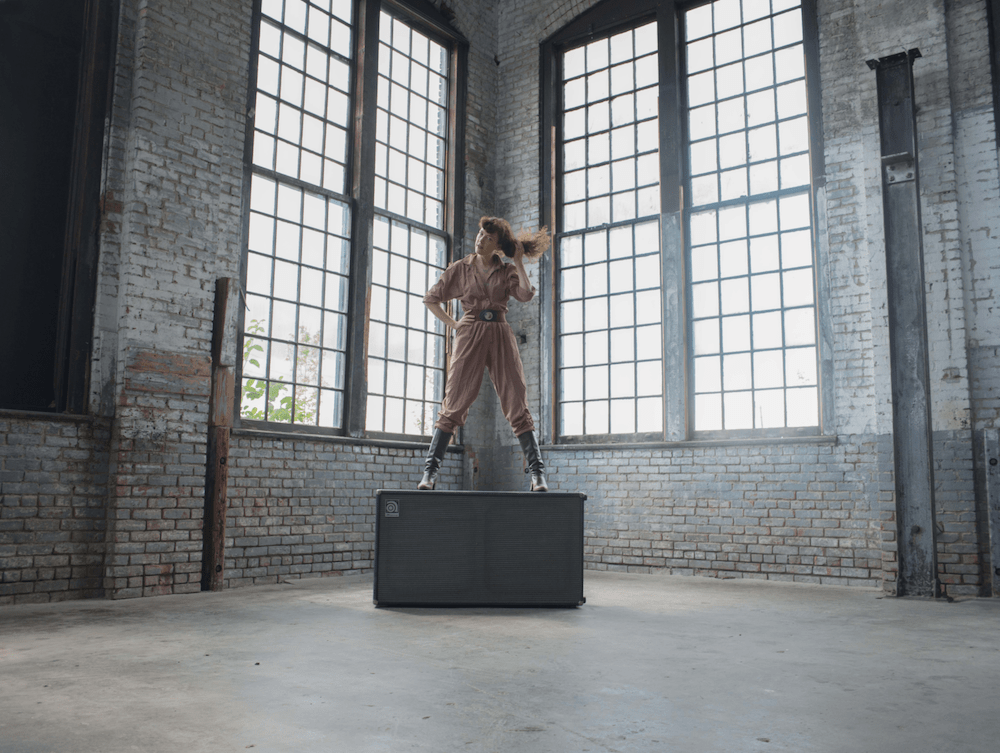
Figure 20: Melissa Auf der Maur, Hudson Basilica, March, 2025. Photo by Eve Alpert.
Audio 6: Conversation with Melissa Auf der Maur, 2025.
Terry Dame (Fig. 21) is an inventor and multi-instrumentalist whose creations — ranging from musical instruments and installations to sonic objets d’art — combine found and devised materials (43). As a composer, sound designer and educator at the School of Visual Arts in New York, she builds sculptural instruments that are both sonically rich and visually striking.
Terry has performed at our Drone Day celebration since its inception. This year (2025), she and my husband Matt constructed an interactive gong tree in the yard, featuring mixing bowls, table saw blades, copper tubes, boxing bells, gongs and more. Terry’s inventiveness, humour and generous spirit are part of what makes Drone Day so special.
Audio 7 features an excerpt from our conversation about her relationship to drone music, including her influences from Balinese gamelan, North and South Indian, Persian and Balkan musical traditions — all of which have inspired her original compositions. She also keeps bees (or, as she says, they keep her) and finds their constant drone to be a grounding and sustaining influence on her listening. In our conversation, she reflects on the value of free play, improvisation, and joy in music; qualities that Drone Day fosters and which, she believes, are more vital than ever today.

Figure 21: Terry Dame, Catskill Art Society. August 5, 2025. Photo by Peggy Shaw.
Audio 7: Conversation with Terry Dame, 2025.
Steve Gorn (Fig. 22) is a Grammy Award winner (2011) and five-time nominee who has performed with luminaries across Indian classical music, jazz, world music and contemporary improvisation (44). A virtuoso bansuri flutist and clarinettist, he is widely recognised as one of the foremost Indian bansuri players in the world, and is based in the Hudson Valley, NY. We first met in 2000, during a Pilgrim Theatre production of Jean-Claude van Itallie’s play based on The Tibetan Book of the Dead, for which I had composed a live sound score. Steve had composed a score in 1983 at La MaMa in NYC, for the first iteration of the play. This remount brought us together and we have been friends ever since.
In Audio 8, Steve speaks about his decades-long relationship with drone music, particularly in the context of North Indian classical traditions. He shares his reflections on the psychological, physiological and emotional effects of listening to drone, as well as his thoughts on being a vital part of our Drone Day celebration each year.

Figure 22: Steve Gorn, Blacksmith Studio, Rosendale, NY May 25, 2025. Photo by Holly Shelowitz
Audio 8: Conversation with Steve Gorn, 2025.
Michael Jay (Fig. 23 and 24) is a sound artist, sound healer, gong master and co-founder of One Tone, a sound healing training programme and instrument distributor (45). He has been a close friend and collaborator for many years and plays a central role in our annual Drone Day celebration. Each year, the day begins with MJ on the Drone Stage, playing a wall of gongs to set the “tone” and welcome everyone into the world of drone. He has long worked with drone instruments — particularly gongs — in performance contexts, including collaborations with jazz musicians such as Melvin Gibbs of the group Harriet Tubman, and Tomchess on oud.
During the COVID lockdown, we recorded an album together in our living room, titled Language of the Alchemists, featuring gongs and steel cello. An excerpt from that recording can be heard in Audio 9. Beyond this conversation through music, Audio 10, then, features a conversation through words.
Audio 9: Excerpt from the album Language of the Alchemists, with Michael Jay and Katie Down on gongs and steel cello.

Figure 23: Michael Jay and Katie Down and their collaboration titled Steel this Gong on the Drone Stage. Marlboro, 2024. Photo by Renee Bergan.

Figure 24: Michael Jay, Sage Academy, Woodstock. August 2017. Photo by Renzo Zanelli.
Audio 10: Conversation with Michael Jay, 2025.
Skylar Antoine (Fig. 25) is a young conceptual artist, sound artist and performer based in Montréal, Canada. She has attended our Drone Day celebrations for the past three years. She created two sound collages drawn from various performances in 2023 and 2024, capturing something of the sonic environment shaped by the many artists passing through (Audio 11 and 12).

Figure 25: Skylar Antoine sitting under photograph by Bill Loeb, May 24, 2025. Barn in Marlboro. Photo by Katie Down.
Audio 11: Drone Day sound collage #1 by Skylar Antoine, 2023.
Audio 12: Drone Day sound collage #2 by Skylar Antoine, 2024.
DISCUSSION
The musical drone is like a sonic mandala: a centre of focus, meditation, connection and presence. It creates a container for thoughts and feelings to flow and take form. Drone Day calls us into this space — to play, to listen, to lie down, to be immersed, curious and connected, in a shared field of sonic play. Many describe it as their favourite day of the year, in part because it is defined by communion, by musicking together, and by the absence of commercial transaction. Of course, its organisation has mandatory production costs, and we do not depend on institutional funding. There is a donation link, but no monetary exchange is required for participation. The potluck is a gesture of collective care, with lovingly prepared food and drink that reflects the same tenderness and thoughtfulness people bring to their sonic offerings. In the months leading up to Drone Day, I notice the excitement — past performers reaching out early to reserve the date, to be sure they can return.
This kind of devotion feels particularly poignant in our increasingly transactional, polarised world. Drone Day resists that polarisation. It celebrates music and sound that gently awakens a sense of oneness, through subtlety, consistency, and the grounding pull of the drone.
I have attempted to account for all the artists who have performed at our Drone Day – their names are listed in alphabetical order, below. I hope to have included everyone, and apologise if somehow I have missed a few. The list keeps growing – and we hope to keep expanding…
Adam O’Callaghan
Adam Taylor
Adrian DiMateo
Al Margolis
Alastair Drew-Penn
Andrea Williams
Andrew Neumann
Andy Rhinehart
Barbara Gogan
Ben Brown
Ben Holmes
Bob Lukomski
Brandon Terzic
Brian Ales
Calvin Grad
Carter Thornton
Coraline Ada Ehmke
Craig Chin
Craig Douglas
Dan Lindy
Daniel Kelly
Dave Schneider
David Budd
David Freeman
David Garland
David First
David Mason
Dean Jones
Dominic Cordisco
Eileen Moran
Eleonore Weill
Elana Bell
Elizabeth Pupo Walker
Elliot Hyatt
Eric Archer
Eric Fraser
Fanny Perez Gutierrez
Francesca Genco
Gabriel Andruzzi
Gabriel Townsend Darriau
Greg Squared
Hatim Belyamani
Hearn Gadbois
Henry Lowengard
Honeydrippers
Irman Peck
James Liam
Jane Rigler
Jeffrey Lependorf
Jessica Bonds
Jessica Caplan
Jessica Lurie
Jill Burton
Jimmy Garver
Jody Diamond
John Lutz
John Minks
Jon Glancy
Josh Geisler
Joseph Fanaberia
Joule L’Adara
Joseph Schmidlin
Kara Allen
Ken Butler
Kenji Garland
Leese Walker
Lisa Knowles
Lorin Sklamberg
Luana DeAngelis
Luke Cornwell
Lucia Modesto
Madelyn Capozzi
Madison Strizic
Marco Dianese
Mary Cordelia Myers
Matt Darriau
Matt Motel
Matt Samolis
Matthew Fass
Matthew Talmage
Max Kutner
Michael Barret
Michael Jay
Michele Marzulli
Miguel Frasconi
Oren Neiman
Onome
Peter Blum
Plaster Cramp
Quince Marcum
Rager
Rima Fand
Rob Rosas
Rolf Sturm
Rufus Capadoccia
Samer Ghadry
Sama Shakti
Sarah van Buren
Sasha Bogdanowitsch
Scary Mountain Wizard
Sean Condron
Shawn Feeney
Siewli Stark
Skylar Aung-Thwin
Stephanie Rooker
Steve Gorn
Sydney Cash
Tamalyn Miller
Tamara Yadao
Terry Dame
Theresa Lyn
Thom Uliasz
Timothy Hill
Tom Law
Tony Cenicola
Vinny Colandrea
William Loeb
Zach Layton
REFERENCES AND NOTES
1. See, for example: Harry Sword, Monolithic Undertow: In Search of Sonic Oblivion (Nashville: Third Man Books, 2022). And Robin Purves, “Subject of the drone“, Metal Music Studies 6, No.2 (2020), p. 145 – 159. Also Roderick D. Cannon, The Highland Bagpipe and Its Music (Edinburgh: John Donald/Edinburgh UP, 1988). Or Martin Clayton, Time in Indian Music: Rhythm, Metre, and Form in North Indian Rāg Performance (Oxford University Press, 2000) . And The Ashgate Research Companion to Minimalist and Postminimalist Music, edited by Keith Potter & Kyle Gann (Routledge, 2013).
BACK
2. Official website from Marie LeBlanc Flanagan: <https://marieflanagan.com>, accessed December 2025.
BACK
3. David Reck, Music of the Whole Earth (New York: Scribner, 1977) p. 43.
BACK
4. Martin Buber, I and Thou (New York: Charles Scribner’s Sons, 1958) p. 16. First published in 1923.
BACK
5. Hazrat I Khan, The Music of Life (New Lebanon, N.Y.: Omega Publications, 1988) p. 335.
BACK
6. Joachim-Ernst Berendt, The World Is Sound: Nada Brahma, Music and the Landscape of Consciousness (Rochester, VT: Destiny Books, 1991) p. 16.
BACK
7. Pauline Oliveros, Sonic Meditations (Kingston, NY: PopandMoM Publications, 1971) p. 5.
BACK
8. Kay Gardner, Sounding the Inner Landscape: Music as Medicine (Rockport: Element Books, 1997. First published in 1990).
BACK
9. See Oliveros (1971) p.iv [7.]
BACK
10. Stephen Nachmanovitch, Free Play: Improvisation in Life and Art (New York: Penguin Putnam, 1990) p. 51. For a discussion on how the phenomenon of entrainment applies in music therapy, see also Klaus Starcke, Julia Mayr & Rainer von Georgi, “Emotion Modulation through Music after Sadness Induction: The Iso Principle in a Controlled Experimental Study”, International Journal of Environmental Research and Public Health 18, No. 23 (2021).
BACK
11. Gardner (1997) p. 28 [8.]
BACK
12. Richard Kostelanetz, ed., John Cage: An Anthology (New York: Da Capo Press, 1991) p. 7. First published in 1970.
BACK
13. Silvia Nakkach, Free Your Voice: Awaken to Life Through Singing (Boulder, CO: Sounds True, 2012) p. 211.
BACK
14. Abdullah M Alshami, “Pain: Is It All in the Brain or the Heart?”, Current Pain and Headache Reports 23 (2019).
BACK
15. Gary Ansdell, Music for Life: Aspects of Creative Music Therapy with Adult Clients (London: Jessica Kingsley Publishers, 1995).
BACK
16. Peter M Hamel, Through Music to the Self: How to Appreciate and Experience Music Anew (Boulder, CO: Shambhala Publications, 1979).
BACK
17. Hamel (1979) p. 100 [16.]
BACK
18. Julian Johnson, After Debussy: Music, Language, and the Margins of Philosophy (Oxford University Press, 2020). Particularly relevant here is the chapter “Mélisande and the Silence of Music”, pp. 51 to 89.
BACK
19. John F Szwed, Space Is the Place: The Lives and Times of Sun Ra (Duke University Press, 2020. First published in 1997).
BACK
20. Ansdell (1995) [15.] quoting Martin Buber, I and Thou (New York: Charles Scribner’s Sons, 1958).
BACK
21. Donald W Winnicott, Playing and Reality (New York, NY: Routledge Classics, 1971) p. 55.
BACK
22. Christopher Small, Musicking: The Meanings of Performing and Listening (Middletown, CT: Wesleyan University Press, 1998).
BACK
23. Suzanne Gieser, The Innermost Kernel: Depth Psychology and Quantum Physics. Wolfgang Pauli’s Dialogue with C. G. Jung (Stockholm: Springer-Verlag Berlin Heidelberg, 2005).
BACK
24. Gieser (2005) p. 199 [23.]
BACK
25. Jamie James, The Music of the Spheres: Music, Science, and the Natural Order of the Universe (New York: Grove Press, 1993) p. 216.
BACK
26. Arnold Schoenberg, The Theory of Harmony (Berkeley: University of California Press, 1922).
BACK
27. Schoenberg (1922) p. 318 [26.]
BACK
28. Eileen D McKusick, Tuning the Human Biofield: Healing with Vibrational Sound Therapy (Rochester, VT: Healing Arts Press, 2014) p. 78.
BACK
29. Nakkach (2012) p.46 [13.]
BACK
30. Pauline Oliveros, Software for People: Collected Writings 1963–1980 (Kingston, NY. Pauline Oliveros Publications, 2015) p. 28. First published in 1984.
BACK
31. Oliveros (2015) p.17 [30.]
BACK
32. Murray Schafer, The Soundscape: Our Sonic Environment and the Tuning of the World (Rochester, VT: Destiny Books, 1977) p. 80. Reprinted in 1993 and 1994.
BACK
33. See “Speech by Honorary Doctorate Recipient Hildegard Westerkamp at SFU”, 2024 <https://hildegardwesterkamp.ca/resources/PDFs/writings-pdf/Honorary_DR_presentation-2024.pdf>, accessed December 2025.
BACK
34. Murray Schafer, Foreword to Sonic Experience: A Guide to Everyday Sounds ed. by A McCartney and H Torgue (Montreal & Kingston: McGill‑Queen’s University Press, 2005). First published in 1995.
BACK
35. Claude Schryer, “Searching for the Sharawadji Effect: Electroacoustics and Ecology”, Musicworks No. 70 (1998).
BACK
36. Sal Randolph echoes this idea eloquently in “Sharawadji Mix”, 1 April 2025, <https://www.salrandolph.com/sharawadji-mix>, accessed December 2025.
BACK
37. Official website from Craig Chin: <https://www.errant.space>, accessed December 2025.
BACK
38. Official website from Tamalyn Miller: <https://www.tamalynmiller.com>, accessed December 2025.
BACK
39. Official website from Matt Darriau: <https://mattdarriaumusic.bandcamp.com>, accessed December 2025.
BACK
40. Official website from Ken Butler: <https://kenbutler.squarespace.com>, accessed December 2025.
BACK
41. Sarah van Buren on Sound Cloud: <https://soundcloud.com/sarah-van-buren-1>, accessed December 2025.
BACK
42. Official website from Melissa Auf der Maur: <https://www.chronogram.com/arts/sound-check-melissa-auf-der-mauers-music-recommendations-20168479>, accessed December 2025.
BACK
43. Official website from Terry Dame: <https://www.terrydame.com>, accessed December 2025.
BACK
44. Official website from Steve Gorn: <https://stevegorn.com>, accessed December 2025.
BACK
45. Official website of One Tone and Michael Jay: <https://www.onetone.one>, accessed December 2025.
BACK
ABOUT THE AUTHOR, REVIEWERS AND EDITOR
Author
Katie Down > SoundWell Creative Arts Therapy Center
Sound artist, multi-instrumentalist and licensed creative arts therapist whose work integrates trauma-informed practice, mindfulness and deep Listening. She teaches widely, including at SUNY New Paltz, and develops therapeutic and artistic projects that explore sound’s capacity to support healing, embodied awareness and interdisciplinary creative engagement.
Reviewers
Joel Ryan > STEIM & Institute of Sonology
Composer, performer and pioneer in computer music associated with STEIM and the Institute of Sonology. Renowned for developing real-time digital instruments and interactive systems, he collaborates extensively with experimental musicians and dancers, advancing innovative approaches to improvisation, live electronics and expressive sonic control
Maile Colbert > Faculty of Fine Arts Lisbon
Intermedia artist, composer and researcher whose work integrates sound, ecology, cinema and immersive media. Grounded in field recording and environmental engagement, her projects include hybrid performances, installations and compositions exploring perception, place, memory and modes of attentive, embodied listening within contemporary artistic practice.
Raquel Castro > CICANT / Lusófona University
Researcher and curator working across sound studies, acoustic ecology and documentary practices. Founder of the Lisboa Soa festival, she develops projects examining urban soundscapes, environmental awareness and community-based approaches to sonic culture, integrating artistic creation with research into listening, ecology and public space.
Editor
Adriana Sá > CICANT / Lusófona University
Artist and researcher working at the intersection of sound, performance and interactive media. She investigates perception, embodiment and interface design, integrating intuitive artistic practice with rigorous research. Her work examines how interfaces can function simultaneously as expressive systems and critical tools for exploring technologically mediated experience.
Continue with LIVE INTERFACES Volume 3: